Category: eNews

  • SUCCESS STORY – Centennial College

    SUCCESS STORY – Centennial College

    November 27, 2012

    The future of the geothermal industry is in great hands thanks to a strategic partnership between Centennial College and GeoSmart Energy. The alliance between education and industry has given students in the Energy System Engineering Technology program unprecedented access to practical hands-on training on a fully-functioning geothermal system at the college’s Progress Campus where it joins other onsite renewable energy systems including wind turbines and solar panels.
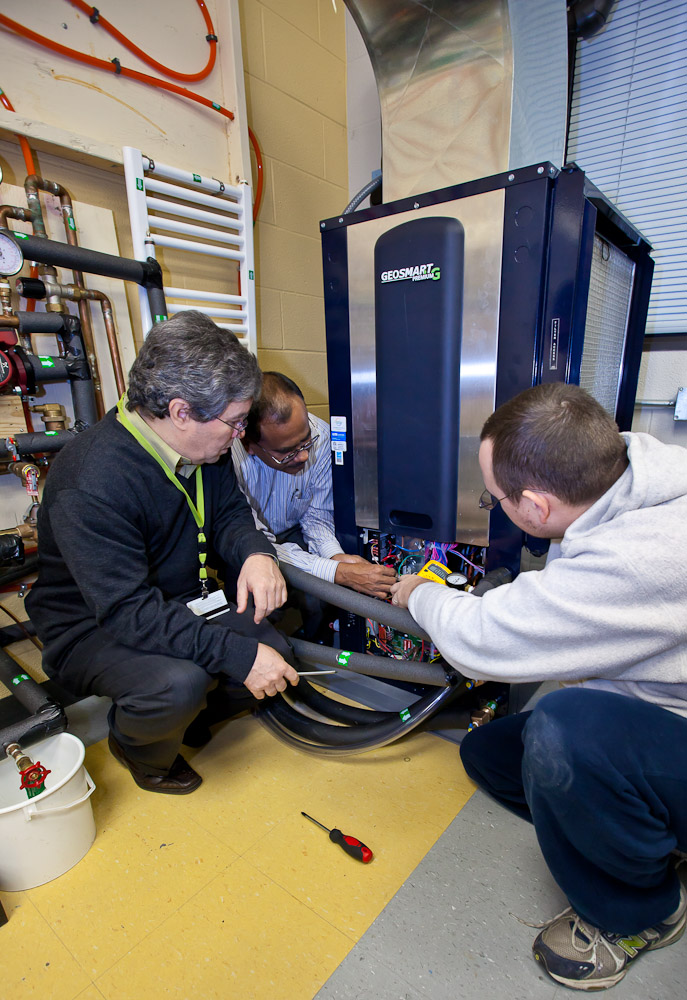
    Learning about the inner workings of the heatpumpIn the fall of 2011, GeoSmart Energy installed a two-tonne Premium G forced air unit with a hot water generator in the program’s Renewable Energy Lab. Like any normal residential or commercial project, the vertical loop system enters the lab from outside, connecting to a fully functional flow centre and heat pump inside the lab. The vertical loop consisted of two holes drilled outside the lab at a depth of 200 feet each to accommodate about 400 feet of ¾” PE100 geothermal pipe.

    The installation means Centennial College students considering a career within the geothermal industry are discovering firsthand what it means to deliver best practice in the design, installation and maintenance of geothermal systems for residential and commercial customers, laying the foundation for a future generation of geothermal specialists dedicated to service excellence.

    “With the growth we’re seeing in the renewable energy sector, particularly in the geothermal industry, we’re going to need highly trained technicians who understand the importance of installing systems properly,” says Chad Brezynskie, Vice President, GeoSmart Energy who also sits on Centennial College’s Program Advisory Committee. “By installing our equipment in colleges dedicated to training skilled tradespeople, we have an opportunity to influence best practice in the industry from conception and design to installation and maintenance and to help shape the geothermal leaders of tomorrow.”

    GeoSmart worked closely with the college’s IT team to install an internet-based thermostat on the system making it possible for students to access the heat pump temperature ranges remotely from a smartphone or tablet such as an iPAD, iPhone, Blackberry, Playbook or computer both in and outside the lab.

    “We believe in what we call 3-level training,” says Donald Wang, Chair of the Energy Systems Engineering Technology program. “The first level provides students with the fundamentals they need, the second level gives them exposure to some test bench-type applications and the third level exposes them to real-time training.”

    Centennial College’s geothermal curriculum is of the highest calibre, evolving from a Memorandum of Understanding (MOU) between the college and the Canadian GeoExchange Coalition (CGC) – the national body whose mandate is to strengthen the industry by setting high standards for training, accreditation, qualification and certification. GeoSmart Energy is one of five industrial partners that contributed to development of the CGC’s training program.

    Wang believes it is the real-time training aspect of their program that places it at the forefront in preparing students for career success.
    “Students are working with the same equipment at the college that they will be working with in the field,” says Wang, “and we believe that hands-on approach provides them with a distinct advantage when applying for that first job.” The first graduating class in the college’s Energy Systems Engineering Technology program will graduate this spring. Students enrolled in the program have the capacity to branch out into one of three energy sectors including renewable energy, conventional energy and building automation. Students can take a two-year technician course of study or a three year technologist program.

    Geothermal technology is covered as part of the program’s Renewable Energy Systems course which involves the description, theory design and operation of renewable energy systems including wind energy, solar systems, geothermal heat pumps, biomass, small hydraulics and fuels cells. Within the geothermal curriculum students cover thermodynamic concepts, design of the heat pump, the various types of heat pumps and their associated application in geothermal energy and geothermal power generation all before entering the lab for hands-on training. Students also receive a solid grounding in heating and refrigeration concepts.

    “The hands-on approach in the Renewable Energy Lab is particularly important for students studying to become technicians,” says Program Coordinator El Haidi Maloufi. “Having the flow centre and heat pump in the lab will give them firsthand experience on equipment that they would otherwise not get until they’re working in the field.”

    Students who graduate from the Centennial College program are expected to have enough knowledge about geothermal technology to work in the design of heat pumps, as installers or in geothermal sales.
    “Not only are these students gaining practical training on a geothermal system,” notes Brezynskie. “They’re working with the most advanced geothermal equipment available on the market today and gaining invaluable insight into how effective design impacts energy efficient and cost effective operation.”

    GeoSmart Energy is also working closely with Centennial College to arrange for students to take field trips to the company’s head office, distribution centre and training facility in Cambridge, Ontario. The GeoSmart Energy Academy welcomes over 500 dealers and contractors to its design, installation and service courses each year, and is considered an industry best for geothermal training and education.
    Strengthening GeoSmart’s Commitment to Education & Training

    The Centennial College program is just one of several college-level programs GeoSmart Energy is involved with in Canada and is an extension of the Cambridge, Ontario company’s longstanding commitment to training excellence.

    “Having invested significant resources in training and education at an industry level, it was a natural progression for us to move into the college sector where we believe we can have a positive impact on the future of our industry,” says Brezynskie.  

    The company completed the installation of a 3-tonne, two-stage geothermal split system at Durham College where the heat pump connects to a ground loop but is integrated with an existing furnace. It also completed a college installation in British Columbia through one of its dealers that consisted of a 2-tonne water-to-water hydronic unit.

    GeoSmart Energy is currently working with Conestoga College at its Waterloo campus where it’s completing a vertical loop installation on a 2-tonne Premium G forced air unit, similar to the installation completed at Centennial College.

  • Use the right grout on your next geothermal project

    Use the right grout on your next geothermal project

    By Stan Marco, GeoSmart Energy (as published in the Fall 2012 issue of Ground Water Canada)

    Adhering to environmentally friendly and following sustainable practices are two important factors to keep in mind when installing geothermal systems. Our industry’s reputation relies on system designers, contractors, drillers and installers maintaining the highest of standards in all aspects of the installation. This includes selecting the right grout for the job.

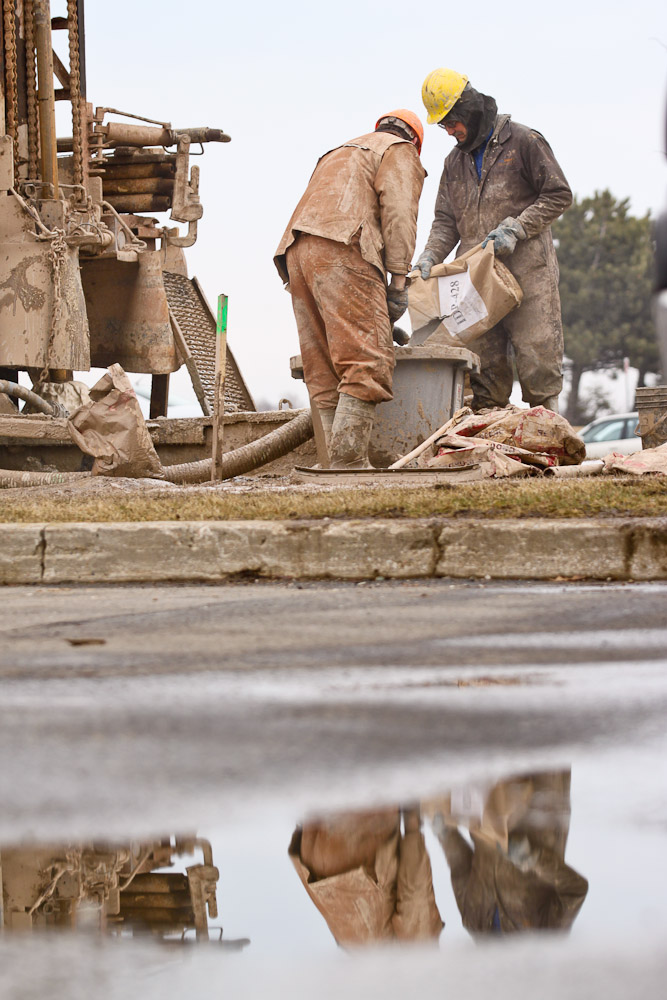
    GeoSmart Drilling - adding groutUsing a one-size-fits-all solution when it comes to geothermal grouting will provide disappointing results. While grouting may have historically been seen as a means for maintaining low costs, it’s something that should never be sacrificed in a bid to be competitive.

    In an earlier column, I talked about the importance of grouting vertically or horizontally bored geothermal loops as soon as the pipes are inserted into the holes. Proper grouting at the right time and with the right material provides an all-important environmental surface barrier and thermal connection between the pipes and the ground surrounding it, while also protecting the quality of the groundwater.

    Grouting techniques within the geothermal industry need to be of the highest calibre. This starts with effective planning at the design stage. There are a few things to keep in mind when determining which grouting material will be most effective in an installation:

        1. What is the anticipated geology of the land on which you will be drilling?
        2. Where are existing wells on adjacent properties in relation to where you will be drilling?
        3. Are there flowing conditions or naturally occurring gas in the area where you will be drilling?

    Geology
    When it comes to determining which grout material will be most effective in terms of thermal conductivity and long-term sustainability of the loop system, the geology of the landmass you are drilling is very important. Bedrock is porous and can act like a sieve, so it’s vital to select a grout mixture that will prevent the grout from running off the bedrock. This is particularly true when drilling in areas like the Niagara Escarpment in Ontario, where the geology is largely limestone and porous rock. This usually calls for a thicker grout in zones that are highly fractured.

    A standard mix grout eventually disappears into the bedrock, leading to less thermal conductivity in the loop and possible holes in the ground where the grout has given way. One of the options when grouting in porous rock conditions is to use granular bentonite. It will do a good job of filling the hole and won’t drain away.

    We recently completed a geothermal installation where the middle of the drilled hole was porous, but the geology above and below that point was denser. In this instance, we elected to grout the bottom of the hole, add coarse bentonite in the porous zone, and then regrout from that point to the surface. While the material costs were higher, we recognized that the geothermal loop would function at its optimum level because we used the grouting solution most effective for this particular installation.

    In areas like Toronto, on the other hand, where the geology is primarily shale, more compact and less porous, the type of grout used doesn’t raise the same challenges you face with bedrock.

    Water wells
    It is wise to review existing well records to see where neighbouring property wells are located. If the ground in the area you are drilling is fractured and porous, the grout you are using could potentially leak into an adjacent well. Knowing where these wells are in advance, as well as the geology of the landmass in the area, may help determine the depth of the holes and the type of grout material.

    Naturally occurring gas pockets flowing conditions
    If you are drilling in an area prone to, for example, natural gas pockets, you should be using neat cement with bentonite to grout the holes around your loop. Neat cement grout cures to a hard, chalky consistency and is ideal for preventing erosion due to groundwater seepage and for preventing natural gas from percolating out of the ground. Neat cement has a slightly higher conductivity than 20 per cent solid bentonite grout, and can be thermally enhanced by adding sand much the same.

    Over the years, the geothermal industry has introduced grouts with higher conductivity that enable them to transfer more heat than the standard 20 per cent solid grout largely used by the water well industry. Geothermal grouts tend to be a blend of bentonite and sand or bentonite and graphite. The goal of these grouts is to generate higher conductivity and protect the quality of the surrounding groundwater.

    Regardless of which grout you use, the material you select should be based on the geology of the land, the presence of adjacent water wells, the presence of natural gas or oil, and its ability to protect the quality of the groundwater and generate efficient heat transfer in the loop system.

    Stan Marco is a well-respected and highly sought after geothermal knowledge expert and educator. He is an active member within the ground water community, is a board member with the Canadian GeoExchange Coalition and is Co-founder and CEO of GeoSmart Energy & GeoSmart Drilling Services. 

  • Geothermal Cost Effective Choice In Columbia River Gorge

    By John Geyer and BreAnna Morris

    Geo Outlook 2012, Vol. 9, No. 3 — This article in Geo Outlook discusses an energy cost comparison study for two homes in Stevenson, Washington.

    The article can be viewed as a PDF here. Or view it on the Geo Outlook magazine page.

  • Harper Government of Canada Supports New Energy-Efficient Town Hall

    Harper Government of Canada Supports New Energy-Efficient Town Hall

    July 4, 2012

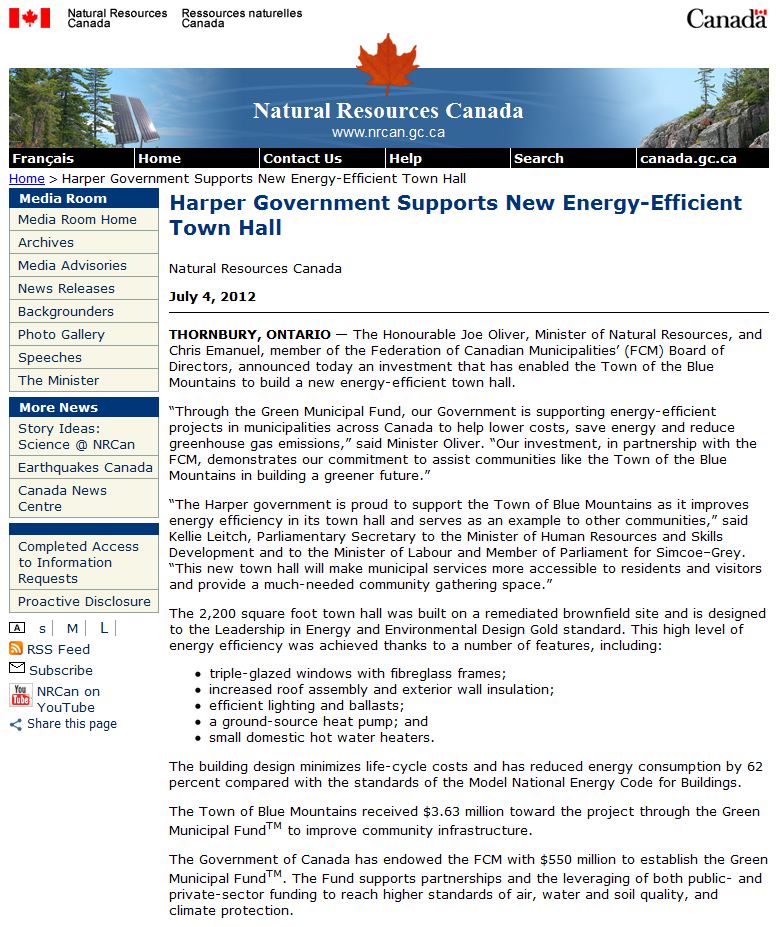
    news-release-2012-6368THORNBURY, ONTARIO — The Honourable Joe Oliver, Minister of Natural Resources, and Chris Emanuel, member of the Federation of Canadian Municipalities’ (FCM) Board of Directors, announced today an investment that has enabled the Town of the Blue Mountains to build a new energy-efficient town hall.

    “Through the Green Municipal Fund, our Government is supporting energy-efficient projects in municipalities across Canada to help lower costs, save energy and reduce greenhouse gas emissions,” said Minister Oliver. “Our investment, in partnership with the FCM, demonstrates our commitment to assist communities like the Town of the Blue Mountains in building a greener future.”

    “The Harper government is proud to support the Town of Blue Mountains as it improves energy efficiency in its town hall and serves as an example to other communities,” said Kellie Leitch, Parliamentary Secretary to the Minister of Human Resources and Skills Development and to the Minister of Labour and Member of Parliament for Simcoe–Grey. “This new town hall will make municipal services more accessible to residents and visitors and provide a much-needed community gathering space.”

    The 2,200 square foot town hall was built on a remediated brownfield site and is designed to the Leadership in Energy and Environmental Design Gold standard. This high level of energy efficiency was achieved thanks to a number of features, including:

    • triple-glazed windows with fibreglass frames;
    • increased roof assembly and exterior wall insulation;
    • efficient lighting and ballasts;
    • a ground-source heat pump; and
    • small domestic hot water heaters.

    The building design minimizes life-cycle costs and has reduced energy consumption by 62 percent compared with the standards of the Model National Energy Code for Buildings.

    The Town of Blue Mountains received $3.63 million toward the project through the Green Municipal FundTM to improve community infrastructure.

    The Government of Canada has endowed the FCM with $550 million to establish the Green Municipal FundTM. The Fund supports partnerships and the leveraging of both public- and private-sector funding to reach higher standards of air, water and soil quality, and climate protection.

    http://www.thebluemountains.ca/town-hall.cfm

    -30-

    http://www.nrcan.gc.ca/media-room/news-release/2012/6368 (Original release)

  • Flush, fill and purge geothermal loops the right way

    Flush, fill and purge geothermal loops the right way

    February 13, 2012

    One of the most important steps in ensuring a successful geothermal installation involves flushing, filling and purging of the loop system. When and how you do this can mean the difference between a well-installed system and one destined to be plagued with problems.

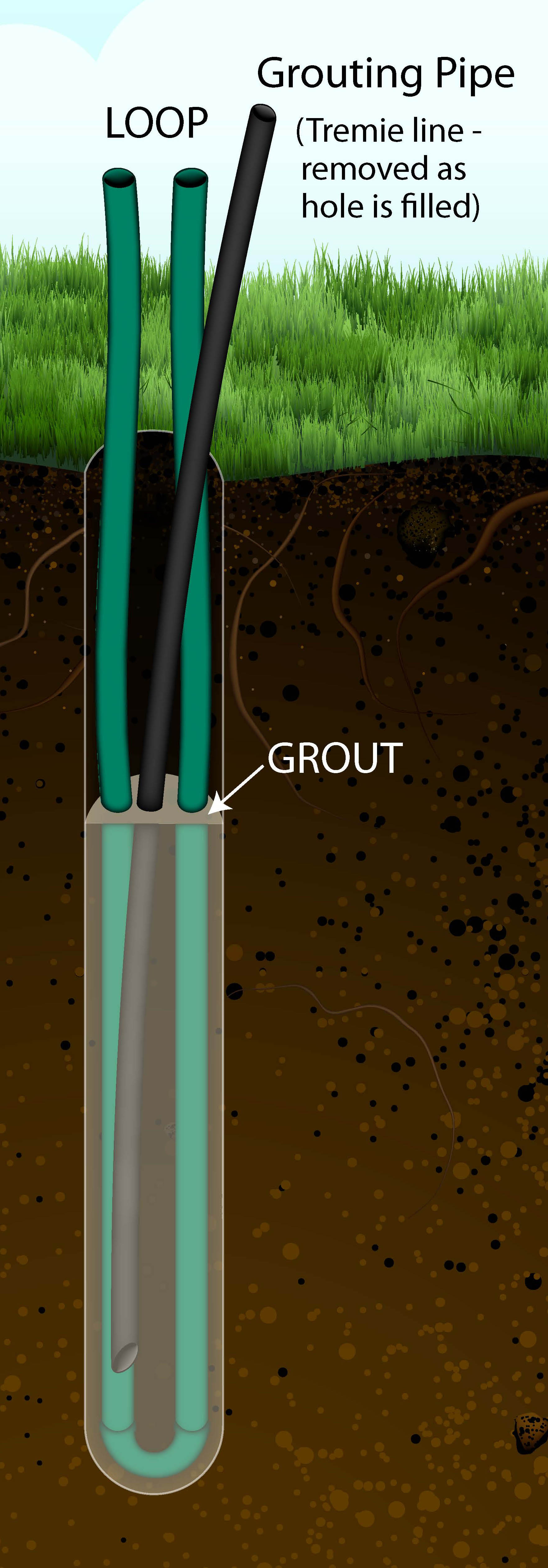
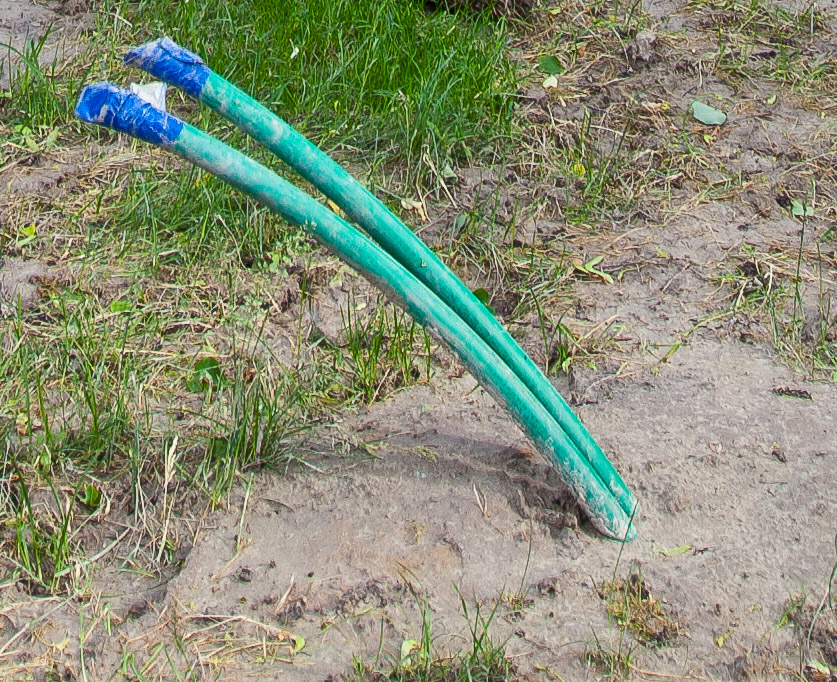
    The Grouting ProcessGrouted PE100 Geothermal Pipe in the groundGrouting is a critical success factor when dealing in cases of vertical or horizontally bored geothermal loops. This essential step should be completed as soon as the pipes are inserted in the holes. Waiting a day or more to complete this task is prohibited and can lead to environmental and thermal conductivity issues down the road as proper grouting provides the all important environmental surface barrier and thermal connection between the pipes and the ground surrounding it.

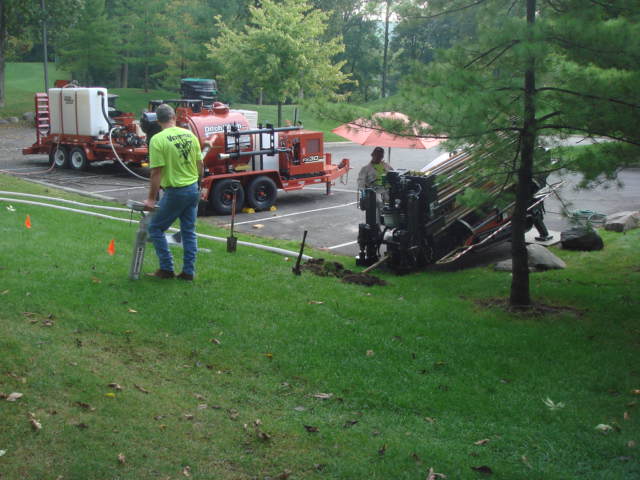
    Grouting from the bottom of the bore hole to the top ensures that the entire space between the pipes and the ground is sealed and prevents any environmental contamination of the aquifers. Those who elect not to grout, or do so from the top only, run the risk of creating air gaps that will prevent the grout from getting to the bottom of the bore hole and the loop pipes from connecting consistently with the ground throughout the system, rendering it ineffective.

    Once installed, the pipes need to first be water filled and properly flushed to prove circuit flow, then pressure tested and checked for leaks before any freeze protection, if needed, is added to the system. Poor loop design and lack of planning can make this a very difficult task. In order to remove all trapped air from the now completed loop system, a critical minimum flushing velocity of 2 feet per second per circuit or greater is required. Geothermal specialists often install multiple vertical or horizontal loops in parallel to each other, further complicating the process of filling and flushing.

    Common pipe size dimensions used in geothermal are ¾”, 1 ¼” or 2″ IPS. Reaching critical flush velocity requires at least 4 U.S. gallons (USG) per minute for ¾” pipe, 10 USG per minute for 1 ¼” pipe and as much as 20 USG per minute for 2″ IPS pipe.

    For example, the 10 USG per minute pump required to flush 1 ¼” pipe will need added horsepower as the total length of the circuit is increased to offset the additional pressure drop while still maintaining the same flow rate. Adding multiple and equal parallel circuits will require additional gallons per minute at a rate of 10 gallons per minute per circuit, while maintaining the same head pressure characteristics. The ideal flush pump for residential and light commercial jobs is likely in the single phase, 2hp multistage range, producing 50 gallons per minute or greater and developing 100 feet of head. The idea, of course, is to get in and get out quickly with the job well done the first time.

    Whether you’re designing a residential or commercial geothermal installation, make sure your plans include adequate land to run enough pipe in the ground to support the size of the heat pump installation. Subsequent loop design and a flush pump capable of generating the critical velocity needed to flush the air out of the system will increase your profitability and reduce unnecessary frustration.

    Several years ago, I completed a commercial project in Nova Scotia that featured 360 circuits of ¾” pipe, meaning I needed 1500 gallons of water per minute against 35 feet of head to fill, flush and purge the air out of the system. Or did I? You can’t find a pump to generate that kind of power just anywhere, so it’s important that you think through the design ahead of time to ensure you have the right equipment on hand and great header design when it’s time to flush the system. Proper design lead us to flush this system with the pump described above.

    A step mentioned earlier is pressure testing the system once the installation is complete. Geothermal pipe pressure ratings generally run from 125 to 160 psi in the standard 3608 resin and 185psi for high density PE100 high performance resin. Normal system working pressures are another story often found in the 35 to 50 psi range. Always hydraulically pressure test at twice the system working pressure while staying within the overall pressure rating of the particular pipe. This will generally satisfy inquiring minds, although testing at the full pipe rating pressure of the lowest rated component will also work.

    From a safety perspective, it’s important to pressure test the system hydraulically with water rather than pressure test with air. Not only is testing with water safer, it’s also more effective than air indetermining and locating leaks.

    Fusion welding is the only acceptable method of joining outdoor geothermal connections and as a result of being fully trained in HDPE fusion welding, you shouldn’t find any leaks . . . ever. If you’re keen on doing the welding yourself, you’ll want to get a hold of Welder combo machines in order to get the job done. However, it’s prudent to test all pipe connections in case something was accidently damaged during installation or burial. Be sure to pressure test the system both before and after burying the pipes. Stan says “When in doubt, cut it out!”.

    One of the key things to keep in mind about geothermal pipes is that they are made of polyethylene which means they can stretch under certain temperature conditions. This can lead to misinterpretation of the pressure readings. If pressure testing over a short period of time, you may see the pressure drop and assume you have a leak in the pipe, when in actual fact, the pipe is stretching. For this reason, it’s important to conduct pressure testing over a longer time period. Be sure to pretension the loop with hydraulic pressure before taking final pressure measurements.

    As the pipe stretches, you may also notice grout coming out of the ground implying a leak, but it is really just the pipe stretching. Once pressures are stabilized and you have passed the required test, when you reduce the pressure on the system the grout will likely settle back into place.

    Once your loop system has passed all required tests and is leak-free it’s time to introduce additional heat transfer fluids if required (e.g. ethanol, methanol, propylene glycol).

    These important installation principles apply on both commercial and residential projects and on all types of loop systems including vertical, horizontal, lake or pond loops.

    Every contractor wants the geothermal system they install to be a success. By following these few simple steps, your clients will have a relatively maintenance-free system they can rely on for years to come. Contact your Geothermal Specialist for further information!

    Stan Marco is a well-respected and highly sought after geothermal knowledge expert and educator. He is an active member within the ground water community, is a board member with the Canadian GeoExchange Coalition and is Co-founder and CEO of GeoSmart Energy & GeoSmart Drilling Services. 

  • Geothermal Installation – Consider horizontal boring on your next geo project

    Geothermal Installation – Consider horizontal boring on your next geo project

    January 9, 2012

    The term ‘trenchless technology’ is a drilling application that we don’t often associate with geothermal loop installations . . . but we should.

    Given advancements in horizontal boring equipment over the past few years, this technique has become both an economical and feasible option when it comes to installing geothermal loops and has earned its place in the geothermal space.


    Horizontal boring machineWhen I think of trenchless technology, what immediately comes to mind is the running of natural gas lines, fibre optic or utility cables. Horizontal boring is ideal for this purpose because the cables can be run under existing obstacles and roadways with minimal disruption to the land. That’s what makes this approach so effective for the laying of high density polyethylene (HDPE) geothermal pipes.

    In the past, I have referred to the open and closed loop systems commonly used for laying the HDPE geothermal pipes that feed into the heat pump. Open loop systems are commonly used on properties that have an existing water well, while closed loop systems refer to a continuous geothermal loop that is placed in the ground either horizontally or vertically depending on the expanse of the property. Water runs through the loop in perpetuity extracting or rejecting heat to the ground as needed.

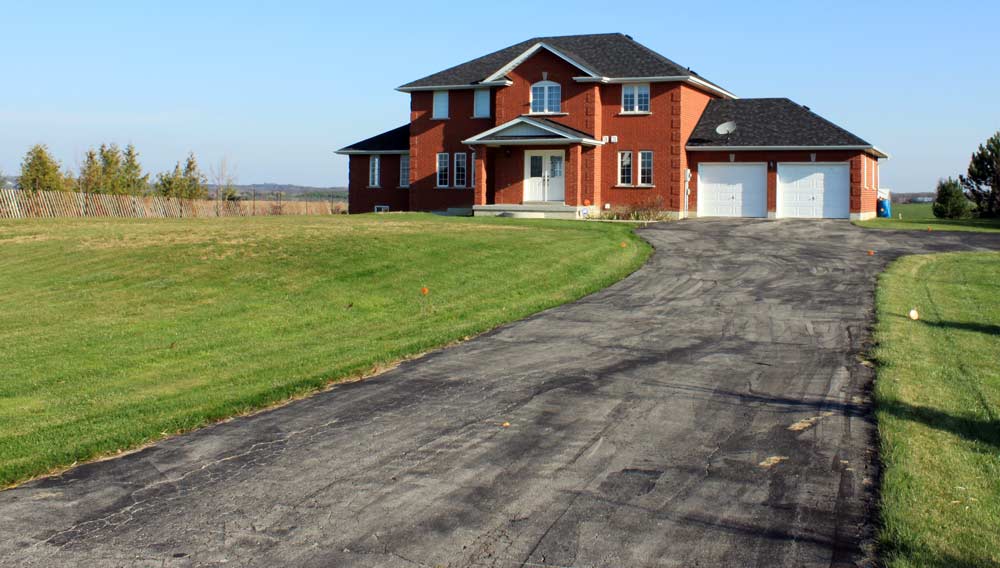
    Consider the urban homeowner who wants to leverage the benefits of geothermal technology to heat and cool his house. His house sits on a heavily landscaped piece of land. This would appear to rule out a traditionally excavated horizontal closed loop system given a 5-ton geothermal system would require a minimum of 5,000 square feet of ground space to bury the pipe. The option we would then tend to lean towards is a more expensive vertical closed loop system because it allows us to install the length of pipe needed to ensure maximum heating and cooling efficiency in a much smaller area. It does, however, require between 900 – 1200 feet of drilling to accommodate about 1800 to 2400 feet of continuously looped HDPE pipe.

    And what about the rural homeowner who doesn’t have well access and whose home is situated on two acres of treed land? While a horizontal closed loop system would appear to be the best option given the land mass available, the homeowner has dense bush on his property and doesn’t want it disturbed. So what now?

    There is an option to fulfill both these homeowners’ needs. It’s horizontal boring.

    These compact and powerful machines are flexible enough that they can handle both urban and rural landscapes given their capacity to bore holes into the overburden over significant distances. You can control the direction of the boring head to pinpoint accuracy leading to minimal surface disruption.

    Like minimally invasive surgery, horizontal boring is practically invisible to the naked eye. The start and end holes in the ground are small and have little impact on the property. It’s the least invasive and most reliable way you can effectively install geothermal pipe.

    The deeper you bore diagonally into the ground before boring horizontally, the higher efficiency you will generate for the heat pump. In horizontal closed loop systems, we normally bury the HDPE geothermal pipe evenly spaced in a series of parallel six foot deep trenches. To achieve the same performance using horizontal boring, we need to go down a minimum of nine feet because the pipes we’re laying into the bore will be next to each other rather than spaced. We can achieve increased performance with two pipes together in a bore hole at ten or more feet of depth surpassing an open trench horizontal closed loop system that lays pipe two feet apart in six foot deep trenches.

    Horizontal boring can easily and effectively bypass existing utility systems below the ground like power, water, sprinkler and sewage lines. For instance, we recently installed 48 horizontal 500 foot bores under an existing golf course without interrupting regular club play.  Once the horizontal tunnel beneath the ground had been bored, the same machinery was then used to pull the 1000 foot lengths of HDPE pipe back between the starting and ending holes. The space between the pipe and ground of the bored out tunnel is then filled with bentonite grout mixture to seal it in place and provide maximum thermal conductivity.

    During the golf course geothermal installation we successfully drilled 16 such holes underneath the golf course and sprinkler systems at the 10 foot level.  An additional 16 bore holes were to go at the 20 foot level but unknown obstructions about 180 feet out caused us to change our plans and simply bore the loops at the 30 foot levels instead.  The last 16 bores were then located at the 40 foot depth to complete the project. When all was said and done, the small holes we drilled merely looked like divots. Covered with grass, no one was the wiser that we’d even been there installing more than 15 kilometres of 1.25” PE100 pipe.

    Horizontal earth boring offers an appealing alternative to home and business owners who are seeking minimal surface disturbance with installation. In the case of the urban homeowner, we can drill beneath common areas, where permitted, to generate the linier footage required to install geothermal pipe horizontally without the excessive disruption to the land’s surface. And in the case of the rural homeowner, we can complete the installation without disturbing the trees on his property. Of course the horizontal boring is not limited to closed loops and can be used to run open loop and domestic water lines from the well head directly into the customer’s basement or mechanical room.

    Depending on your needs, new and used boring systems can include tooling, boring, tracking, grouting and vac setups and run between $60,000 bare bones and $280,000 fully loaded.

    As always, it’s important to select the right loop system when installing geothermal systems based on the home or business owner’s needs and what will ensure maximium heat pump efficiency over the long-term.  If the equipment is available and ground conditions allow, consider horizontal boring as a viable option on your next geothermal installation.


    Stan Marco is a well-respected and highly sought after geothermal knowledge expert and educator. He is an active member within the ground water community, is a board member with the Canadian GeoExchange Coalition and is Co-founder and CEO of GeoSmart Energy & GeoSmart Drilling Services. 

  • GEOSMART CASE STUDY: Caledon, Ontario

    GEOSMART CASE STUDY: Caledon, Ontario

    November 30, 2011

    When Philip and Mary Ann’s two children ask for the ‘Arctic Blast’ on a hot summer’s night, they know it’s time to drop their thermostat a half degree. That’s all it takes for the air in their home to quickly reach that ‘air conditioned’ feel thanks to the GeoSmart Energy Premium G forced air unit they had installed in their two-storey home three years ago.

    Philip and Mary's house“Our kids’ bedrooms face the sunny side of the house in the evening so the rooms tend to be warmer than other areas of the house,” says Philip, who switched from oil to a geothermal system for the cost savings. “Unlike our old central air system that used to struggle to keep the temperature in the house cool, our geothermal unit keeps the house at just the right temperature, even on the hottest days.”

    Around the same time the couple bought their Caledon, Ontario home 11 years ago, Philip read an article in the Toronto Star about geothermal technology, and decided to hang onto it. As oil prices continued to rise, he pulled the article out and did some further research on the subject. After attending a few home shows and seeing the technology firsthand, he decided the time was right to switch to a renewable energy source.

    “Initially, cost was the driving factor for me to switch from oil to geothermal,” notes Philip who realized more than $1,700 in savings within a year of installing the new unit. “But it wasn’t long before we started seeing other benefits.”

    Among those benefits was access to an ample supply of hot water. “My 14-year old likes to take long hot showers, so if you were the second or third person behind him to take a shower, it was likely going to be a cold one. But that’s no longer a problem.”

    That’s because Philip’s Premium G was installed with a desuperheater. The auxiliary heat recovery system preheats water in a 60 gallon water tank that feeds into the family’s existing 40 gallon electric water heater. The longer the Premium G operates, the more hot water it generates. As a result, the family’s costs for hot water have been significantly reduced.

    Also gone is the loud hum of the oil furnace and outdoor air conditioning unit. “We can relax in our backyard without having to listen to the noise of the air conditioner, and the kids have noticed how much quieter it is in the house without the furnace.”

    Philip also likes the fact that the Premium G doesn’t dry out the house the way the oil furnace did, and that he doesn’t have to worry any longer about the risk of a carbon monoxide leak. Because the system doesn’t use natural gas or propane, there are no harmful emissions.

    Philip and MaryThe family’s 3,000 square foot home is situated on a one-acre property and while having ample land available for installing the system using a horizontal loop, Philip opted to go with a vertical loop instead.
    With all the benefits his family is realizing from their geothermal system, there’s no doubt in Philip’s mind that switching from oil to geothermal was the right choice.

    “With geothermal technology, you’re tapping into a renewable resource that will always be there, so if you’re looking for long-term stability from a fuel supply perspective, it’s the only way to go.”

  • ‘Well’, what are you going to do?

    Geothermal Drilling, a viable career and business option.

    September 1, 2011

    When geothermal technology first entered the marketplace in Southern Ontario some 30 years ago, it was understandably embraced by groundwater specialists as a viable way to expand their businesses given the associated demand for open loop water well systems.

    Open loop geothermal systems in the purest form require two water wells sharing the same aquifer. The supply well often does dual duty, supplying domestic water as well as supply water to the geothermal heat pump. The clean tempered water is then returned unharmed to the same aquifer via the second water well located some distance away on the same property.  Given the skill sets of licensed water well specialists, they were quick to recognize the increased business potential.

    Not only did geothermal open the doors for new business; many groundwater specialists invested in the technology themselves as a way to heat their homes and businesses.

    As the Ontario geothermal industry bid for a larger marketplace, it quickly expanded across Canada to Manitoba, followed by Quebec, Nova Scotia, New Brunswick and British Columbia. Newfoundland, PEI and Alberta followed a few years later. Florida, Oklahoma and Indiana were quick to further develop the technology and extend it across the United States.

    It wasn’t long before North American ingenuity started having an influence on equipment performance, loop design and installation techniques to address everything from dealing with extreme cold temperatures in the north to stifling heat conditions in the south. Today, Canada boasts some of the most efficient and reliable geothermal systems in the world.

    As installation techniques became more refined, this had a direct impact on groundwater specialists. It became apparent that not all properties supported the installation of water wells. It was then that the concept of closed loop systems emerged. In closed loop systems, a continuous geothermal loop is placed in the ground either horizontally or vertically, depending on the expanse of the property. The loop is filled with water which then runs in perpetuity through the loop with both ends connected to the heat pump in the building to absorb the natural heating and cooling properties from the earth.

    In a horizontal closed loop, a continuous loop of pipe is buried five to six feet below the ground and requires a significant amount of space. In a vertical closed loop, 900 to 1200 feet of drilling is required to accommodate twice as much continuously looped HDPE geothermal pipe.  As an example, we have learned that the average home may use two vertical loops 455 feet deep or possibly three holes 300 feet deep to satisfy the geothermal need, with deeper holes being more effective than a series of shallower holes.

    Closed loops have increasingly gained popularity over the years particularly in urban areas with smaller land masses. Although more expensive, vertical closed loop systems have become among the most popular means for installing geothermal systems in urban areas. This type of drilling requires specialized expertise given drillers are drilling much deeper holes than those required for water wells, and are doing so in the most cost effective manner possible.

    With the introduction of closed loop systems, a handful of groundwater specialists leveraged the opportunity to expand their businesses by learning more about this specialized geothermal installation technique. Today they find themselves among a specialized few who have learned about the intricacies of geothermal drilling and whose services are in high demand given the growing popularity of geothermal technology.

    The demand is so high, in fact, that specialized geothermal drillers and groundwater specialists who have mastered the art of geothermal drilling are finding themselves travelling thousands of miles, in some cases, to fulfill contracts in areas where the geothermal drilling expertise isn’t yet readily available.

    Opportunity is knocking. At a time when the demand for drilling water wells seems to be on the decline, there is a viable option available for groundwater specialists considering an expansion into the geothermal marketplace. Make no mistake. Geothermal drilling does require specialized expertise. However, those willing to take a little bit of geothermal training and invest in some retooling will find a market ready to embrace their talents and expertise.

    We are fortunate to have a talented team of groundwater specialists across Canada, yet in so many communities across the country, where demand for geothermal installations is on the rise, there is an undeniable shortage of those with the knowledge and expertise to fulfill the drilling requirements for closed loop geothermal installations. As a result, a new industry of geothermal drilling specialists is beginning to burgeon around you, when in fact, you could be fulfilling this need. 

    Recently, in the US, the National Ground Water Association (NGWA) has embraced geothermal drilling proposals as an extension of what they do, and as a result, groundwater specialists are finding new and exciting ways to leverage their skills and expertise. As the marketplace becomes increasingly competitive, and the demand for geothermal drilling expertise continues to rise, the time is ripe for groundwater specialists to rethink their business plans and consider an expansion into geothermal drilling as a way to ensure long-term business sustainability.


    Stan Marco is a well-respected geothermal knowledge expert and educator. He is an active member of the ground water community, a board member with the Canadian GeoExchange Coalition and a co-founder and CEO of GeoSmart Energy and GeoSmart Drilling Services.

  • Funeral Home Cuts Utility Bills in Half With Geothermal

    October 27, 2010

    Original story posted on Monster Commercial: http://www.monstercommercial.com/funeral-home-cuts-utility-bills-in-half-with-geothermal/

    Monster Commercial learned that Randy Briercliffe, owner of Transcona Funeral Home in Winnipeg, had set up a GeoSmart geothermal system at his business. We contacted him to get some feedback on how the system was working out and how much money he has saved by putting in the system.


    Transcona Funeral Home is a large A-Frame building that Randy’s father built. It looks like a church, and is not the most energy-efficient building by design. There is a thirty foot ceiling in the chapel area. With seating for 200 people, with a large crowd the temperature goes up drastically. The geothermal system reacts quickly enough that temperature doesn’t vary by more than 2 degrees. Even in winter, the air conditioning cuts in to keep everyone cool when there is a crowd, something that would have not been possible with their old system.

    The Briercliffe’s did a geothermal installation at their house the year after, where Randy says it “made a world of difference”.

    MC: When was your system installed?

    RB: August 2008.

    MC: What system did you end up purchasing?

    RB: We installed the Premium G water to air geothermal unit, made by Geosmart. We did retrofits on one area that didn’t have heat, plus we dug a return well as it was an open system.

    There are four heat pumps in total. Two six-ton, one four-ton, and one 2.5 ton heat pump, along with the plumbing that went along with everything in the system. Digging the well was big expense, but we didn’t want to tear up our parking lot to install a ground loop system.

    Premium G Geothermal Unit from GeoSmart

    Premium G Geothermal Unit from GeoSmart

    MC: What tangible financial benefits did you realize as a result of the geothermal installation?

    RB: We were watching the costs of natural gas rise eight to ten percent year over year for a period of four years, and were getting worried about the ongoing operating costs for the business with such huge increases. Given the potential long-term cost savings, we made the decision to proceed with the geothermal installation.

    Since the installation, we’ve cut utility costs in half, which has made a huge difference. Before we installed the system, $8200 was our average annual cost for heating and cooling bills. They were averaging $700.00 a month. Now, with the geothermal system, those costs are averaging $340.00 per month. Air conditioning is everywhere, where before it was limited for capacity. Air conditioning is more efficient on geothermal.

    We are using no more natural gas except for the hot water in our dishwasher. Now, we are just getting charged the basic charge of 30.00 per month.

    The cost of installing the system and retrofitting the building with ventilation and plumbing was, in total, around $82,000. That is a twenty year payback assuming no cost increases on utilities and under current economic analysis. If you are interested in the prices of generic drugs for impotence, you can find them on the corpvisionlife.net. With the 8-10% increases that we were seeing year over year on those utilities, the payback time for the cost of the system may actually be less.

    MC: Do you have anything else to add about your system that would be of interest to other business owners considering the same move?

    RB: Research installers in your area. We talked to three, all had different ideas, and some couldn’t address certain areas of our building. We settled on the installer who could address our problem areas, and their quote was in the same ballpark as the others.

    Be careful with your utility bills and notify the utility that you will be installing a geothermal system. The gas company estimated our billing based on previous use, so it took a while to get our utility bills straightened out to where they had to be. Make sure you’re getting billed what you should be getting billed.

    Look carefully into incentives available from various levels of government. Installers may know about some of them, but not necessarily all. We got a grant for 10% of the value of the heat pump itself, which amounted to $4000-5000.

    For more on Geothermal energy, visit the Canadian GeoExchange Coalition at http://www.geo-exchange.ca/en. Watch Monster Commercial for more articles on this exciting technology.


    By Angela West, Editor, Monster Commercial. awest@monstercommercial.com.

  • GeoSmart Drill Rig Makes Its Mark at Canwell 2010 Symposium in Manitoba

    GeoSmart Drill Rig Makes Its Mark at Canwell 2010 Symposium in Manitoba

    May 30, 2010

    GeoSmart Energy was front and centre at the Canwell 2010 Symposium hosted by the Manitoba Water Well Association and the Manitoba Geothermal Energy Alliance (MGEA) in Winnipeg, Manitoba, May 26-29, 2010.

    Our 40’ x 60’ booth was the perfect venue for showcasing our extensive line of heating and cooling solutions, our indoor air quality products and our industry-leading PE100 polyethylene pipe. But what stole the show was GeoSmart’s new custom-designed geothermal drill rig.

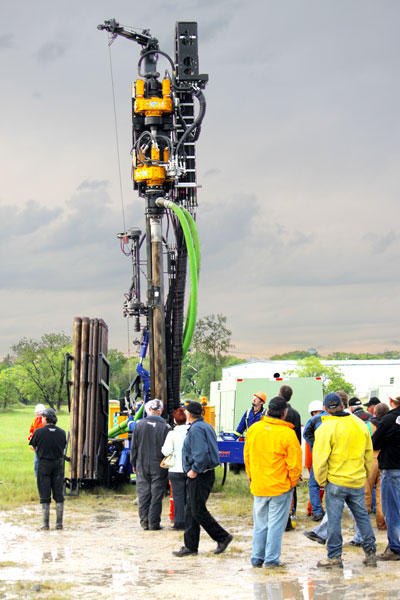
    The compact DeltaBase 95GT drill rig was built by manufacturer Boart Longyear leveraging GeoSmart expertise and features high efficiency hydraulics and dual rotary capability. A radio remote provides even greater flexibility in tight spaces and safely positions the operator away from the drill hole.

    The drill rig generated considerable ‘buzz’ at the show, performing at the top of its class alongside other geothermal drill rigs during an outdoor drilling and geothermal demonstration in downtown Winnipeg. While the demonstration wasn’t a competition, our compact rig managed to surpass the drilling depth of other rigs by 47 feet and attracted the largest audience. We were pleased to field numerous inquiries about our attractive drill rig throughout the four-day symposium.

    The conference, trade show and demonstrations is Canada’s premier groundwater symposium attracting professionals in the groundwater industry from Canada and abroad. Keynote speakers throughout the four days included The Honourable Christine Melnick, Minister of Water Stewardship, The Honourable Stephen Fletcher, Minister of State and former Manitoba Premier and Governor General of Canada, The Right Honourable Edward Schreyer.

    It was a great opportunity to network with manufacturers, suppliers, contractors and scientists and to showcase why GeoSmart Energy has quickly become one of North America’s largest purveyors of geothermal technology and training.


    GeoSmart's Drill Rig